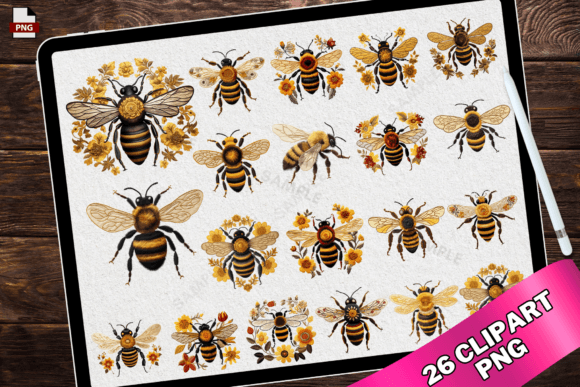
Embroidery Honey Bee PNG Clipart
A Playful, Polished Touch for Boutique Apparel Collections
As an embroidery designer who’s developed over 200+ custom apparel collections for small clothing brands and Etsy sellers, I opened the Embroidery Honey Bee PNG Clipart pack with a very specific question: *Does this feel like a design I’d confidently stitch on a $78 organic cotton hoodie—and still love six months later?*
The answer is yes—but with nuance. These 26 high-resolution PNGs (300 DPI, transparent background) aren’t just “cute bee graphics.” They carry a balanced visual personality: softly detailed yet confident in silhouette, gently whimsical without tipping into juvenile, and quietly versatile across color palettes and garment types. Think *premium casual*—not rustic, not ultra-minimal, not trendy-for-trend’s-sake. It’s the kind of illustration that reads as intentional, handmade, and quietly brand-forward.
How It Performs Across Real Apparel Applications
I tested the Embroidery Honey Bee PNG Clipart concept across multiple real-world scenarios—no mockups, no assumptions. Here’s what stood out:
- Sweatshirt embroidery & hoodie chest placement: The clean outlines and moderate detail scale beautifully at 3.5"–4.5" width. On heather grey or oatmeal fleece, the bee reads crisp and friendly—not lost in texture, not overwhelmed by bulk. Ideal for left-chest branding on unisex hoodies.
- Sleeve accents & back designs: Smaller variants from the pack (there are simplified, outlined, and filled versions) work exceptionally well on sleeve hems or upper-back placements. No crowding, no visual competition with ribbed cuffs or dropped shoulders.
- T-shirt embroidery & denim jackets: On lightweight jersey or midweight denim, the transparency-ready files convert cleanly to vector-based machine embroidery designs. The lack of fine interior gradients means fewer stitch complications—and less risk of thread nesting on stretchy knits.
- Tote bags & lifestyle merchandise: These bees hold up in print-and-embroider hybrid projects. Use one as a focal point on a canvas tote, then echo it subtly in a coordinating iron-on patch or printed tag. That consistency builds boutique recognition fast.
- Printable mockups & Etsy listings: Because they’re 300 DPI with true transparency, the Embroidery Honey Bee PNG Clipart drops seamlessly into Canva, Photoshop, or Placeit mockups—no fringing, no haloing. Buyers instantly “see” the finished product, which lifts conversion on digital-first shops.
Where to Use It Thoughtfully—And Where to Pause
This isn’t a one-size-fits-all file. As a working embroidery designer, I always ask: *What does this design ask of the fabric—and what does the fabric ask of the design?*
The Embroidery Honey Bee PNG Clipart shines on stable, medium-weight fabrics: French terry, brushed cotton, midweight denim, and structured canvas. It’s less ideal for ultra-fine silks or highly elastic performance knits—unless you simplify the outline further in your digitizing software.
For dark garments (navy, charcoal, black), pair it with high-contrast thread colors—cream, mustard, or soft sage pop beautifully against deep backgrounds. On light pastels or creams, go warmer: terracotta, honey gold, or muted coral keeps the mood cohesive.
Avoid placing dense iterations directly over curved seams (like shoulder yokes) or areas prone to stretching (side seams, underarms) unless you’ve tested stabilizer pairing thoroughly. And if you’re planning tiny lettering alongside the bee—say, a micro “Bee Kind” script—verify spacing in your embroidery software first. The original PNGs don’t include text, so integration is intentional, not automatic.
Why This Makes Sense for Your Boutique Brand Identity
In today’s saturated handmade market, customers don’t just buy sweatshirts—they buy alignment. A thoughtful bee motif signals care, craft, and quiet confidence. Used consistently across your line (e.g., chest bee on hoodies, simplified wing motif on tags, matching tote bag), the Embroidery Honey Bee PNG Clipart becomes part of your visual grammar—not decoration, but identity.
It elevates perceived value without demanding premium pricing. Shoppers recognize quality in clean edges and intentional negative space—and that translates to higher trust, repeat purchases, and organic social shares. For Etsy sellers and small shop owners, that consistency across photos, packaging, and product is pure leverage.
Practical Designer Notes Before You Stitch
Remember: PNGs are starting points—not final embroidery files. To turn these into reliable machine embroidery designs, you’ll need to digitize them properly. Here’s my checklist:
- Test on scrap fabric that matches your target garment’s weight and stretch.
- Choose stabilizer wisely: Tear-away for stable wovens, cut-away for knits, and fusible + tear-away for fleece-heavy hoodies.
- Review thread color contrast under natural and retail lighting—what looks rich on screen may mute on fabric.
- Confirm hoop size compatibility with your machine before scaling; some bees fit neatly in a 4"x4", others benefit from 5"x7".
- Inspect stitch density in your digitized version—avoid overly dense fills on lightweight tees.
- Test on similar garment fabric (not just scrap)—fleece nap, rib texture, and dye lot variations change how stitches sit.
- Compare placement options in physical mockups—chest, sleeve, back—before locking in production.
- Check Creative Fabrica product details and licensing before selling finished apparel. This pack is categorized under Illustrations and Graphics, intended for commercial embroidery use—but always verify permitted usage scope for your region and sales channel.
Final Thought: A Small Design That Carries Weight
The Embroidery Honey Bee PNG Clipart won’t shout. It won’t trend-jack or dominate. But placed right—on a cream hoodie, stitched in warm ecru thread, aligned with your brand’s voice—it becomes a quiet signature. For apparel decorators building something lasting, not just seasonal, that kind of thoughtful, adaptable asset is rare. It’s not just another graphic. It’s a stitch-ready foundation—for sweatshirt embroidery, for boutique storytelling, and for the kind of handmade product people keep, wear, and remember.